ABS-201™ for Androgenetic Alopecia
Absci has applied our Integrated Drug Creation™platform to design a differentiated antibody for the treatment of Androgenic Alopecia (AGA)
Absci has applied our Integrated Drug Creation™ platform to design a differentiated antibody for the treatment of Androgenetic Alopecia (AGA)
Overview
Potential best-in-class antibody targeting the prolactin receptor for the treatment of Androgenetic Alopecia (AGA)
Phase 1/2a clinical trial initiated December 2025; interim data anticipated H2 2026
- High affinity and potency
- Excellent developability profile
- Anticipated low immunogenicity
- Extended half-life and expected longer dosing intervals
- Clinical development strategy expected to enable PoC in H2-2026
- Potential to be first to market in the U.S.
Unmet Need for Advancements in Treatment
AGA is an indication with a significant unmet need for advancements in treatment and a potential patient population of approximately 80 million individuals in the United States alone.
AGA is a genetically predetermined disorder due to an excessive response to androgens and can affect up to 50 percent of males and females. It is characterized by progressive loss of terminal hair of the scalp any time after puberty, and follows a characteristic distribution in both males and females. Hair loss is most prominent in the vertex and frontotemporal regions in males. In women, the frontal hairline is typically spared with diffuse hair loss at the crown and top of the head, with loss often marked by a wider center part.
Current FDA-approved treatments for AGA are limited due to variable efficacy, lack of patient compliance, potential sexual and neurological side effects. Additionally, incremental limitations exist for women of reproductive age.
Targeting PRLR
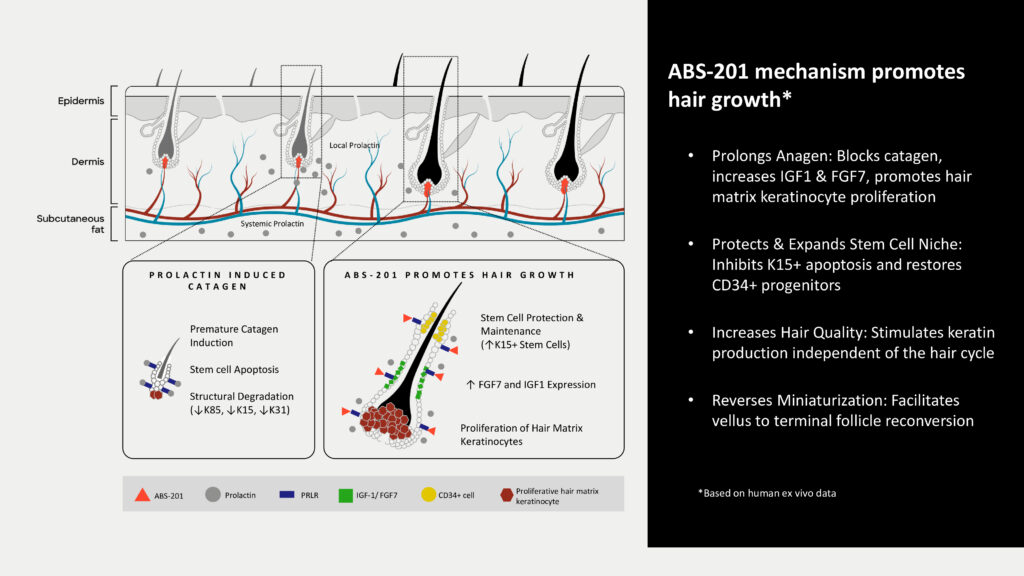
ABS-201 targets the prolactin receptor (PRLR) and in preclinical studies has shown high affinity and potency, favorable safety and immunogenicity, extended half-life for convenient infrequent dosing, favorable developability and manufacturability attributes, and early efficacy data in a short-term hair growth model compared to minoxidil.
The mechanism of action of ABS-201 shifts the balance in hair cycle stage towards anagen phase, with active and new hair growth and prevention of telogen effluvium.
PRLR inhibition is anticipated to be safe and well-tolerated
In multiple human genetics studies1,2,3 reduction or complete loss of PRLR or PRL signaling had no apparent impact on several key physiological functions. In females, there was no observed effect on fertility, breast development, or menses, nor were there significant changes in serum electrolytes and general hormone levels (with the exception of elevated PRL in PRLR mutation carriers). In males, the studies reported no instances of erectile dysfunction or abnormalities of other hypothalamic-pituitary axes. Collectively, these human genetic findings strongly indicate that ABS-201 driven inhibition of PRLR is likely to be safe and well tolerated.
- doi: 10.1056/NEJMoa1307557
- doi: 10.1056/NEJMoa1805171
- doi: 10.1210/clinem/dgab201
Preclinical profile

Superior efficacy when compared to 5% topical minoxidil in mouse hair growth study
The efficacy of ABS-201 was evaluated in a preclinical study for short term hair growth in mice. Mice were shaved until the skin was visible, then randomized into treatment groups based on skin color and initial body weight. Hair growth scores were recorded twice weekly using a predefined scale, and ABS-201 was compared to 5% topical minoxidil.
- ABS-201 increased hair regrowth compared to minoxidil in a short-term hair regrowth model, achieving full hair growth after 22 days, whereas minoxidil only achieved approximately one-third hair growth in the same period.

Interim NHP PK/PD modeling suggests the potential for a low dosing frequency, with the possibility of 2 to 3 doses over 6 months
The half-life of ABS-201 was evaluated in a preclinical pharmacokinetic (PK) study conducted in non-human primates. Antibody serum concentration was evaluated over the course of 56 days, comparing ABS-201 to a PRLR blocking antibody, HMI-115, at the same dose (300 mg/kg IV).
- ABS-201 demonstrated a 3x extended half-life as compared to HMI-115
- The bioavailability of ABS-201 was found to be 90%
- These interim NHP PK data in combination with PK/PD modeling suggest that ABS-201 may only require 2-3 doses over a 6-month treatment period
IND-enabling studies completed for ABS-201
ABS-201 AIMS TO SET THE STANDARD FOR CONVENIENCE AND EFFICACY
- Excellent manufacturability and developability may enable future high concentration formulation targeting 200mg/ml
- Anticipated absolute bioavailability profile in NHPs (>90%) may enable future subcutaneous injection
- > 3x extended half-life vs HMI-115 in NHPs may enable potentially longer dosing intervals of every 8/12 weeks (ABS-201)
Optimization for
High affinity and potency
Excellent manufacturability & developability profile
Anticipated low immunogenicity
Extended half-life and expected longer dosing intervals
High solubility
Great Stability
Clinical trials
Accelerated Phase 1/2a trial designed to deliver safety, tolerability, and PoC
STUDY DESIGN
HEADLINE is a randomized, double-blind, placebo-controlled Phase 1/2a first-in-human study involving up to 227 healthy male and female volunteers across multiple Australian sites. Participants are randomized 3:1.
The dose ranges studied were selected to establish safety and tolerability and ensure a predicted receptor occupancy >90%. The study cohorts include:
- Single Ascending Dose (SAD) initiated December 2025
- Multiple Ascending Dose (MAD), expected to commence 2Q 2026

ENDPOINTS
Primary: Safety & Tolerability
Secondary:
- Pharmacokinetics, Pharmacodynamics
- Hair Regrowth readout vs. baseline @ 13w & 26w in AGA subjects
-
- Target Area Hair Count
- Target Area Hair Width
- Target Area Hair Darkness
-
This drug is investigational and is being studied in clinical trials. Its safety and efficacy have not been established, and it has not been approved by the FDA or any other regulatory authority.
Learn more

Learn more about ABS-201 presented at Absci KOL Seminar 2025


